
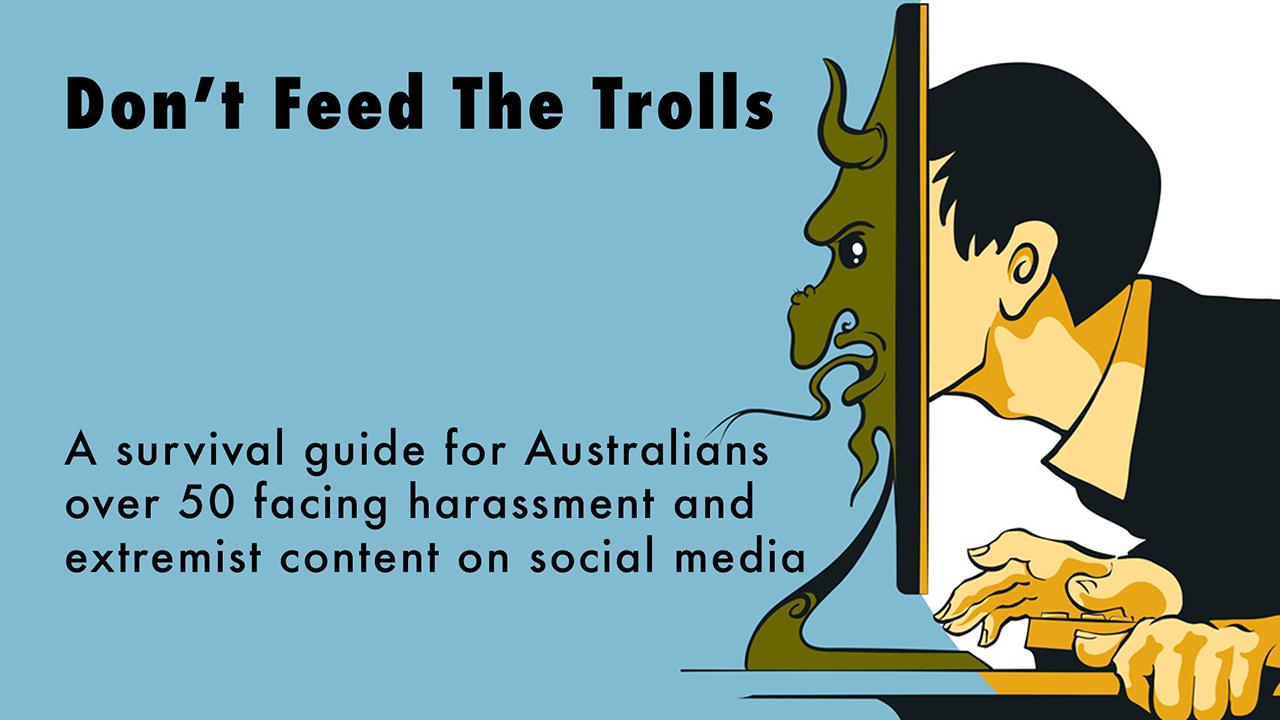
A survival guide for Australians over 50 facing harassment and extremist ideological and political content on social media.
With the rise in political extremism in Australia, online fights and moments make surfing the internet a daunting prospect for many, and exposure to unwanted content has been the focus in the mainstream media, mainly targeted towards youth; however, it impacts us all.
We have put together a handy and practical research-based guide to help you form your own strategy for dealing with trolls and extremists who oppose your views.
Remember that some of the content you see online is auto-generated by bot farms and may not be a real human, but a real person will be behind the ideology. So this content is still relevant, and keeping a record and reporting this content is more important than usual.
This guide is not a substitute for police, legal, financial or mental-health advice. If anyone is in immediate danger, call 000.

1. Know what you are looking at
A troll
A troll tries to provoke an emotional reaction or disrupt an online space for amusement, attention or chaos. Trolling may use baiting, sarcasm, fake outrage, insults, irony or deliberately misleading claims. The person may not even believe what they have written. Their reward is often your reply, the argument and the audience watching it happen. Research describes trolling as deliberately antagonistic online behaviour involving combinations of aggression, deception and disruption (Hardaker, 2010), and links trolling enjoyment with hostile and manipulative behaviour (Buckels, Trapnell and Paulhus, 2014).
Harassment or abuse
Harassment becomes more serious when it is repeated, targeted, threatening, humiliating or intended to frighten, silence or damage you. Examples include threats, doxxing (publishing your private details), impersonation, stalking, pile-ons, hate speech, unwanted sexual material and publishing intimate images without consent. In Australia, eSafety can investigate adult cyber abuse when online content is seriously harmful to the physical or mental health of an adult and meets the relevant threshold.
Extremist content
Extremism is not simply a strong political opinion or an unpopular view. It involves rigid ideological or political goals that support radical social change and may promote hatred, dehumanisation, violence or recruitment. Extremist groups can use trolling, memes and “just joking” language to make extreme ideas look ordinary, test who responds, and move interested people into closed groups. Radicalisation is better understood as a possible pathway involving social identity, perceived threat, group pressure and increasing commitment, not as something caused by one post (McCauley and Moskalenko, 2008).
Why the distinction matters
You do not need to diagnose the sender. You only need to identify the behaviour and choose a safe response. A rude comment may be best handled with mute or block. A sustained attack may require evidence and an eSafety report. A scam needs your bank and Scamwatch. A credible threat of violence needs police or emergency services. Material promoting terrorism or extreme violence can be reported to eSafety; concerns about violent extremist ideology, planned harm or radicalisation can be reported to the National Security Hotline.
The survival method: PAUSE
Put down the phone
Do not answer immediately. Online disinhibition means people can behave more aggressively when anonymity, distance, invisibility and delayed consequences reduce their sense of restraint (Suler, 2004). Your first job is to protect your judgment. Take ten minutes, walk away, or ask someone else to read the message.
Assess the danger
Ask four questions:
- Is there a specific threat to me or someone else?
- Does the sender know my address, workplace, routine or family details?
- Is the content a scam, account takeover attempt or impersonation?
- Does it promote violence, terrorism, recruitment or instructions to harm people?
If there is immediate danger or a crime in progress, call 000. For non-emergency police assistance, call 131 444 where that service operates in your state or territory. If you are unsure whether content is a national-security concern, the National Security Hotline operates 24/7 on 1800 123 400; it also accepts online reports and SMS at 0498 562 549.
Understand before sharing
Do not quote-post, forward or “warn everyone” by reposting the harmful material. Attention can increase its reach. A screenshot saved privately is different from public amplification. Check the account, date, original source and wording. Search for the claim through a reliable source such as an official government site, a reputable news outlet or the organisation being impersonated. Do not assume that a familiar profile photo means the account is genuine.
Misinformation is designed to make you react before you check. Prebunking research suggests that learning common manipulation techniques—such as emotional language, false authority, conspiracy framing and manufactured urgency—can improve resistance to misleading content (Roozenbeek and van der Linden, 2019; Roozenbeek et al., 2022).
Save evidence safely
Before blocking, capture the post or message, username, profile link, date and time. Keep the original URL if possible. Save threatening voicemails, emails and payment details. Write a brief timeline: who contacted you, what happened, what you clicked, what you sent and when. Do not investigate the person yourself, threaten them back or publish their personal information. Store evidence somewhere the harasser cannot access, such as a separate email account or a trusted person’s device.
Exit, report and get support
Use the platform’s block, restrict, mute, limit replies and report tools. Report the behaviour, not just the person’s political viewpoint. After reporting, leave the thread. Tell one trusted person what happened. Serious adult cyber abuse, image-based abuse and illegal or restricted content can be reported to eSafety. If a scammer contacted you through social media, report the account to the platform and Scamwatch. If money or identity information was lost, contact your bank immediately, stop communicating with the scammer, change exposed passwords and report the incident through ReportCyber.
Eight habits that make you harder to harm
1. Make your account boring to attackers
Review who can see your phone number, birthday, address, workplace, family list, photos and posts. Remove public information that reveals your routine or location. Turn off location tagging when you don’t need it. Use a private profile where practical, and review followers or group members you do not recognise. If someone abuses public information, it’s not your fault, but reducing exposure can limit opportunities for targeting.
2. Use a different passphrase for every important account
Your email account is the key to many other accounts. Use a long, unique passphrase for email, social media, banking and superannuation. A password manager can help. Turn on multi-factor authentication (MFA), which requires an additional code or approval after the password. The Australian Cyber Security Centre recommends updates, MFA, backups, long unique passphrases and scam reporting as core protections for seniors.
3. Treat urgency as a warning sign
Stop when a message demands secrecy, immediate payment, gift cards, cryptocurrency, remote computer access, a login code or a “small fee” to unlock a prize or investment. Contact the organisation through a phone number or website you find yourself, not through the message. A real bank, government agency or technology company will not need you to keep a crisis secret from family.
4. Do not argue with a troll
A calm correction can help a genuine reader, but a troll may treat every reply as a win. If you respond once, use a short boundary: “I will not continue this conversation while you are insulting me.” Then stop. Don’t explain your whole life, defend every accusation, or try to expose the troll. Mute, block and report are active safety choices, not weakness.
5. Use a two-person check for suspicious content
Before sharing a shocking claim, ask a trusted person to check it with you. Look for the original source, evidence, date and independent confirmation. If no one is available, wait until the next day. This “slow down” habit interrupts the emotional chain that misinformation and extremist propaganda try to create.
6. Keep your support network offline as well as online
Choose two people who know how to contact you if your account is compromised. Agree to send them a simple message such as “Please call me; I think my account is being attacked.” If harassment affects sleep, confidence or daily life, contact a GP or counsellor. Lifeline provides 24/7 crisis support on 13 11 14, text at 0477 13 11 14, and online chat. If technology is being used by a current or former partner to monitor, threaten or control you, contact 1800RESPECT on 1800 737 732 or text 0458 737 732.
7. Be a safe bystander
If you see someone being targeted, do not join a public fight. If appropriate, save the link, report the abusive content, privately check whether the person is safe, and offer practical help, such as sitting with them while they change passwords. A bystander’s confidence and knowledge affect whether they intervene constructively (Macaulay et al., 2022). Do not share graphic extremist material or the victim’s personal details.
8. Use the right Australian reporting path
- Immediate danger or crime in progress: 000.
- Non-emergency police assistance: 131 444 where available; Crime Stoppers 1800 333 000 for information [2].
- Adult cyber abuse, image-based abuse, illegal or restricted online content: eSafety report.
- Scam or scam account: Scamwatch; if money, identity or a device is at risk, contact your bank and ReportCyber.
- Terrorist material, violent extremist ideology, threats, foreign interference or concern about radicalisation: National Security Hotline 1800 123 400, online report or SMS 0498 562 549.
- Emotional distress: Lifeline 13 11 14.
“I have saved the messages and reported the account. Do not contact me again. Further contact will be reported to the platform and, if necessary, to eSafety or police.”
A message you can copy…
Send this only if it feels safe and useful. You do not owe a troll a final reply. In many cases, the safest response is no response.
AI was used in the voice generation of the included video.
REFERENCES
Australian Cyber Security Centre (2026) ‘Report and recover from scams’, Australian Signals Directorate, available at: https://www.cyber.gov.au/report-and-recover/recover-from/scams (Accessed: 27 September 2026).
Australian Cyber Security Centre (2026) ‘Seniors: Simple steps to protect your personal information and life savings’, Australian Signals Directorate, available at: https://www.cyber.gov.au/learn-basics/explore-basics/seniors (Accessed: 27 September 2026).
Buckels, E.E., Trapnell, P.D. and Paulhus, D.L. (2014) ‘Trolls just want to have fun’, Personality and Individual Differences, 67, pp. 97–102. doi: 10.1016/j.paid.2014.01.016.
Davidson, J., Livingstone, S., Jenkins, A., Gekoski, A., Witzel, M., Derry, K., et al. (2019) Adult online hate, harassment and abuse: A rapid evidence assessment. London: Government Equalities Office, available at: https://research.tees.ac.uk/files/34689333/Adult_Online_Harms_Report_2019.pdf (Accessed: 27 September 2026).
Department of Home Affairs (2026) ‘National Security Hotline’, Australian Government, available at: https://www.homeaffairs.gov.au/about-us/our-portfolios/national-security/security-coordination/national-security-hotline (Accessed: 27 September 2026).
eSafety Commissioner (2026) ‘Adult cyber abuse’, Australian Government, available at: https://www.esafety.gov.au/key-topics/adult-cyber-abuse (Accessed: 27 September 2026).
eSafety Commissioner (2026) ‘Report online harm’, Australian Government, available at: https://www.esafety.gov.au/report (Accessed: 27 September 2026).
eSafety Commissioner (2026) ‘Illegal and restricted online content’, Australian Government, available at: https://www.esafety.gov.au/key-topics/illegal-restricted-content (Accessed: 27 September 2026).
Lewandowsky, S., Cook, J., Ecker, U.K.H., Albarracín, D., Amazeen, M.A., Kendeou, P., et al. (2021) ‘The Debunking Handbook 2020’, The Debunking Handbook 2020, available at: https://sks.to/db2020 (Accessed: 27 September 2026).
Hardaker, C. (2010) ‘Trolling in asynchronous computer-mediated communication: From user discussions to academic definitions’, Journal of Politeness Research, 6(2), pp. 215–242. doi: 10.1515/jplr.2010.011.
Macaulay, P.J.R., Boulton, M.J. and Betts, L.R. (2022) ‘Bystander responses to cyberbullying: The role of publicity, anonymity, type of cyberbullying, and victim response’, Computers in Human Behavior, 130, 107179. doi: 10.1016/j.chb.2022.107179.
McCauley, C. and Moskalenko, S. (2008) ‘Mechanisms of political radicalization: Pathways toward terrorism’, Terrorism and Political Violence, 20(3), pp. 415–433. doi: 10.1080/09546550802073367.
Roozenbeek, J. and van der Linden, S. (2019) ‘Fake news game confers psychological resistance against online misinformation’, Palgrave Communications, 5, 65. doi: 10.1057/s41599-019-0279-9.
Roozenbeek, J., van der Linden, S., Goldberg, B., Rathje, S. and Lewandowsky, S. (2022) ‘Psychological inoculation improves resilience against misinformation on social media’, Science Advances, 8(34), eabo6254. doi: 10.1126/sciadv.abo6254.
Stuart, J. and Scott, R.A. (2021) ‘The Measure of Online Disinhibition (MOD): Assessing perceptions of reductions in restraint in the online environment’, Computers in Human Behavior, 114, 106534. doi: 10.1016/j.chb.2020.106534.
Suler, J. (2004) ‘The online disinhibition effect’, CyberPsychology & Behavior, 7(3), pp. 321–326. doi: 10.1089/1094931041291295.
Lifeline Australia (2026) ‘Crisis support’, available at: https://www.lifeline.org.au/131114 (Accessed: 27 September 2026).
1800RESPECT (2026) ‘Technology and safety’, available at: https://1800respect.org.au/help-and-support/technology-and-safety/online_safety_tips (Accessed: 27 September 2026).

Robert is the founder of AustralianSenior.com.
He studies Journalism and Communications at USC and studied TV Presentation at NIDA. He is passionate about advocating for seniors and presenting non-biased, fact-based news to enable those over 50 to thrive in an increasingly complicated digital world. He covers all areas of life and style, from pop culture to the economy, travel, and events with a passion for supporting rural and regional destinations and opportunities. If it's worth reading, it's worth writing about.
He loves to travel the globe and is a recently diagnosed, late-in-life Type One Diabetic.